
starring Dr. Hal !
PRE-ARCHOSAURIAN PSEUDOSUCHIANS
October 16, 2026 10:00pm
Mixcloud won't play this episode? Listen to the MP3 here
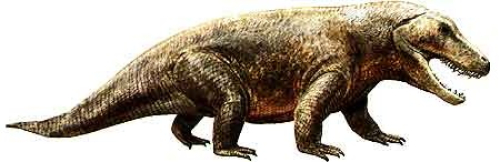
PREDATED CHARISMATIC SAURIANS BETTER KNOWN. So we talk about them a bit. Erythrosuchus was the largest predator of its time, at more than 13.1 feet (4 m4ters) in length, with a singular neural arch suggesting possible lengths of 4.75–5 meters (15.6–16.4 feet). It walked on all fours and had limbs positioned semi-vertically under its body, unlike the more sprawling gait of most earlier reptiles. Its head was large and theropod-like, possibly able to reach a length of 1 meter (3.3 feet), and had sharp, conical teeth.
These dragon-like creatures are deriving of further study.
Erythrosuchus was the largest erythrosuchid, but apart from its size, was largely similar in appearance to other related genera. It had a large head and comparatively short neck. One of the few distinguishing features of Erythrosuchus is the smoothness of the margin of the squamosal, a bone at the rear of the skull. In other erythrosuchids, the margin of this bone projects backward from the skull, giving it a hook-like appearance. In Erythrosuchus, the margin is convex and lacks a hook.
Illustration of a specimen's partial postcrania as it was found, showcasing a complete tail...
All the vertebrae were robust and short (being taller than long), and possessed intercentra between them throughout the column, adding strength and stiffness. One very complete specimen (BMNH R3592, among the largest known of the genus) preserves the entirety of its tail, showing 35 individual caudal vertebrae that diminished in size throughout its length. We speak of its close relative Fasolasuchus. GRONK!